




Mr. Dattatray Waghmode
Search is not what it was a few years ago. Users interact with information differently and increasingly expect instant, precise answers instead of scrolling through long result lists.
For example, someone asking for a Chinese restaurant in Wakad may not want dozens of links. They may want two or three relevant choices that match their location, budget, and preferences. The more direct and personalized the answer, the better.
This change is being accelerated by AI-powered systems such as ChatGPT, voice assistants, and Google's generative search experiences. As these systems become part of everyday search, discussions about SEO, AEO, and GEO are increasingly important.
What Is SEO?
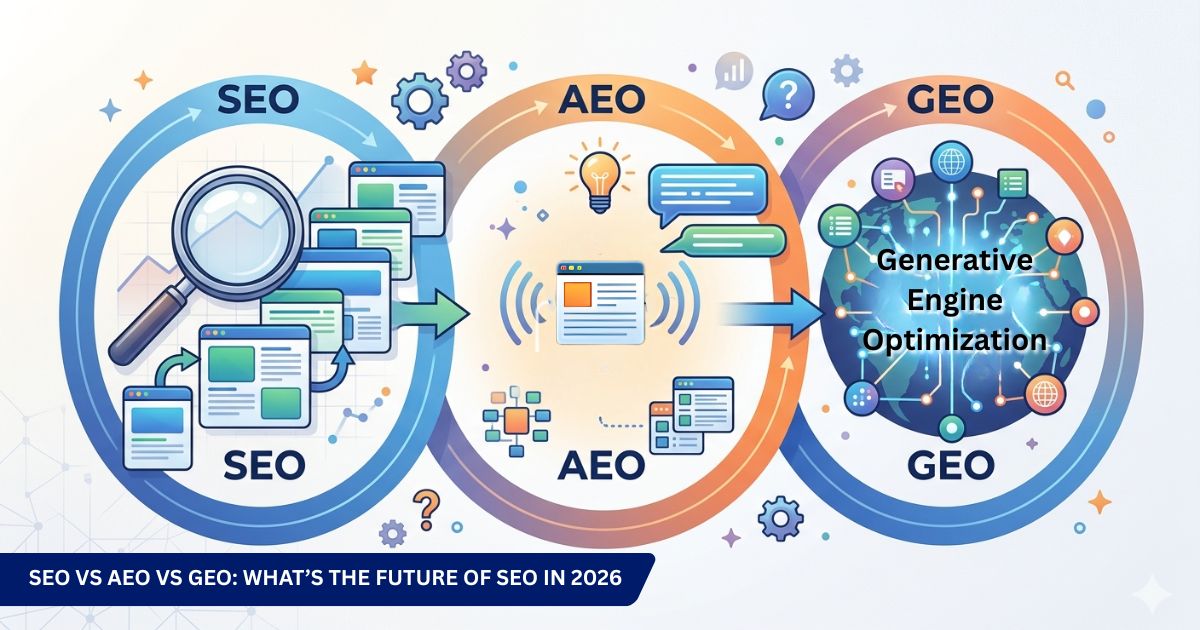
SEO stands for Search Engine Optimization. It improves a website's visibility on search engine result pages. SEO focuses on keyword optimization, backlink building, technical performance, and on-page content quality. Businesses use it to rank higher and drive organic traffic.
SEO remains the foundation of digital visibility, but its methods continue to evolve as search engines become more sophisticated.
What Is AEO?
AEO means Answer Engine Optimization. While SEO focuses on ranking content, AEO aims to provide a direct answer to a user's question.
Important AEO elements include featured snippets, voice search optimization, question-based content, concise answers, and structured data. The goal is no longer only to rank; it is also to become the answer.
What Is GEO?
GEO stands for Generative Engine Optimization. It focuses on making content useful to AI systems that generate answers, including chat-based assistants, AI-powered search engines, and conversational interfaces.
GEO requires content to be contextually rich, well structured, factually clear, and easy for AI systems to interpret. While SEO focuses on rankings and AEO on direct answers, GEO focuses on inclusion in AI-generated responses.
SEO vs. AEO vs. GEO: Key Differences
| Factor | SEO | AEO | GEO |
|---|---|---|---|
| Focus | Rankings and organic traffic | Direct answers | AI-generated responses |
| Primary platform | Search engine results | Featured snippets and voice assistants | Generative AI engines |
| Core strategy | Keywords, authority, and technical quality | Questions, concise answers, and structured data | Context, intent, credibility, and machine-readable clarity |
Why SEO Alone Is Not Enough in 2026
Relying only on traditional SEO limits visibility in a landscape where people can receive answers without visiting a standard results page.
- Rise of AI search: AI-generated results summarize information and can answer complex requirements with fewer clicks.
- Zero-click searches: Users increasingly receive useful information directly on the results page.
- Voice assistants: Voice interfaces often return a single spoken answer, making competition for that answer especially strong.
Businesses therefore need to move from pursuing rankings alone toward earning visibility wherever users ask questions.
Future Strategy: Combine SEO, AEO, and GEO
AEO and GEO are growing, but they do not make SEO redundant. A strong strategy combines all three disciplines.
- Create intent-based content: Understand what users want to accomplish and build content around that need.
- Optimize for questions: Use natural language and provide clear, direct answers.
- Use structured data: Help search engines and AI systems understand the meaning and purpose of your content.
- Strengthen E-E-A-T: Demonstrate experience, expertise, authority, and trust through accurate content and transparent authorship.
Conclusion
SEO is not dead, but it is no longer sufficient in its older form. In 2026, the future of search combines SEO for visibility, AEO for direct answers, and GEO for AI-generated results.
Brands that adapt to this hybrid model can stay visible as search behavior changes. Dexcel Digital Hub helps businesses apply current search and AI optimization strategies effectively. To learn more, email sales@dexceldigitalhub.com.