


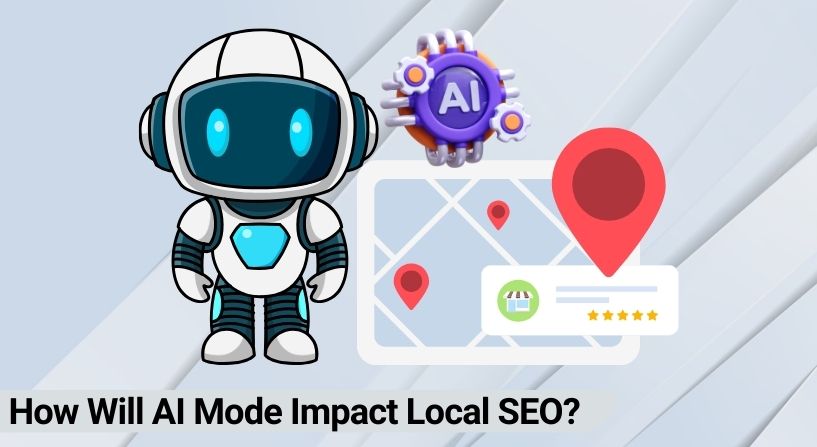
Adapting Local SEO for the AI Era: Moving Beyond Blue Links
The shift from traditional blue links to conversational AI search fundamentally changes how marketers need to approach local SEO. Success now depends on precision, consistent data, and verifiable real-world signals.
The AI Disruption in Local Search
While search engine disruption is nothing new, the integration of AI into Google Search—through AI Overviews and AI Mode—represents a complete transformation rather than a minor update. For marketers managing local SEO across one or multiple locations, the transition from classic blue-link results to a conversational, AI-driven experience has significant implications.
AI Overviews (AIOs), occupying the premium “Position 0” on SERPs, were the first sign of this change. The true game-changer, however, is AI Mode, a fully interactive environment that engages users in multi-step dialogue. It anticipates follow-up questions, providing information without requiring users to click through additional pages.
Data shows that if a business’s content is not cited within an AIO, organic click-through rates can drop by up to 61%.
This means local marketers must now prioritize inclusion in AI Overviews and AI Mode results, rather than merely targeting traditional Position 1 rankings.
The New Local SEO Paradigm: From Links to Entity Authority
AI Mode alters how local search visibility works. For high-intent local queries (e.g., “best walking tour in Chicago”), the AI can replace traditional Google 3-Packs with enriched local packs featuring Google Business Profile (GBP) cards.
Recent studies indicate that AI Overviews now appear for local searches over half the time, especially for informational queries. Behavioral research also shows that GBPs are frequently cited and engaged with in travel and accommodation searches, highlighting their critical role in local visibility.
The AI prioritizes Entity Authority, synthesizing business information from multiple verified sources across the web. Trustworthiness and consistency across all digital channels now outweigh backlinks or isolated website content as ranking factors.
Eight Key Recommendations for Local SEO in AI Mode
To thrive in AI-driven local search, marketers must adopt strategies focused on entity authority, data accuracy, technical compliance, and content designed to answer user questions efficiently.
1. Optimize Your Google Business Profile (GBP)
The GBP is the cornerstone of AI-driven local search data. Full optimization and consistent verification are essential for visibility.
Best Practices:
- Categories: Choose a precise primary category and a limited number of relevant secondary categories. Avoid generic or loosely related categories.
- Services: Ensure all offered services are accurately listed and match website and schema markup details.
- Hours & Attributes: Maintain current operating hours, noting temporary closures. Include payment options, amenities, and differentiators.
- Engagement Signals: Encourage in-store visits, respond to reviews promptly, post updates, photos, and promotions.
Recommendation: Treat the GBP as a live data feed; any change should update the GBP first, then the website, followed by third-party directories.
2. Implement Schema with Technical Precision
Structured data helps AI understand, categorize, and verify business facts. Requirements:
- LocalBusiness & Service Schema: Properly define business type and services.
- Geographical Accuracy: Include latitude and longitude for hyper-local queries.
- Visual Assets: Provide high-quality, properly tagged images.
Visual Assets: Provide high-quality, properly tagged image
3. Ensure Omnichannel Data Consistency (NAP Harmony)
AI relies on consistent Name, Address, and Phone (NAP) information across websites, GBPs, and third-party directories. Any discrepancy weakens trust.
Recommendations:
- Align website and GBP service listings.
- Monitor NAP consistency across all locations and directories.
- Treat structured data and GBP as the authoritative source for all channels.
4. Leverage Authentic Reviews (E-E-A-T)
Experience, Expertise, Authoritativeness, and Trustworthiness (E-E-A-T) remain critical. AI synthesizes customer reviews into summaries, influencing user decisions.
Strategies
- Encourage customers to highlight service attributes (e.g., “fast service,” “knowledgeable staff”).
- Implement Review and AggregateRating schema.
- Actively respond to reviews to strengthen authority and trust signals.
5. Embrace Answer Engine Optimization (AEO) & Query Fan-Out
Content must anticipate user questions beyond the initial query. AI Mode values concise, structured content that answers both the main question and related follow-ups.
Implementation Tips:
- Map latent questions likely to follow initial queries.
- Map latent questions likely to follow initial queries.
- Develop two tiers of content:
- Tier 1: Informational content optimized for AIO citation (guides, FAQs).
- Tier 2: Transactional, local-focused pages with clear calls-to-action.
6. Build Entity Authority Through Branded Mentions
In AI SEO, brand mentions (linked or unlinked) are more valuable than traditional backlinks. AI references mentions across social media, blogs, and forums.
Recommendations:
- Obtain high-quality mentions from authoritative local news, industry blogs, and directories.
- Leverage social media and video platforms (e.g., YouTube) as sources for entity information.
- Shift efforts from low-value link building to digital PR and content distribution.
7. Optimize for High-Intent Conversions (CRO)
Traffic from AI Mode tends to be highly qualified. Focus on conversion optimization rather than raw traffic volume.
CRO Tactics:
- Clear, above-the-fold calls-to-action.
- Minimize friction in forms and booking processes
- Track KPIs tied to direct actions (calls, bookings, directions) rather than general clicks
- Ensure a seamless user experience from AI Mode to website conversion.
8. Ensure Content Accessibility for AI
AI must be able to access core content to assess entity authority.
Recommendations:
- Unhide critical content (licenses, certifications, service details).
- Use plain text and clean HTML for factual information.
- Monitor AI comprehension regularly to ensure critical information is crawlable and indexed.
IThe Generative AI Mandate for Local SEO
AI Mode shifts the focus from traditional link-based strategies to a precision, fact-driven approach. To secure visibility:
- Maintain strict technical compliance (schema and content).
- Ensure data integrity across all digital channels.
- Use Answer Engine Optimization to cover the full spectrum of user queries.
- Earn branded mentions, linked or unlinked, in authoritative spaces.
This strategic pivot—from chasing traffic to establishing verified entity authority—is essential to protect click-through rates and capitalize on AI-driven, high-intent local traffic. Businesses must now serve as trustworthy sources of structured, verifiable data for AI citation. The time to adapt is immediate.
Source Reference: Search Engine Journal