


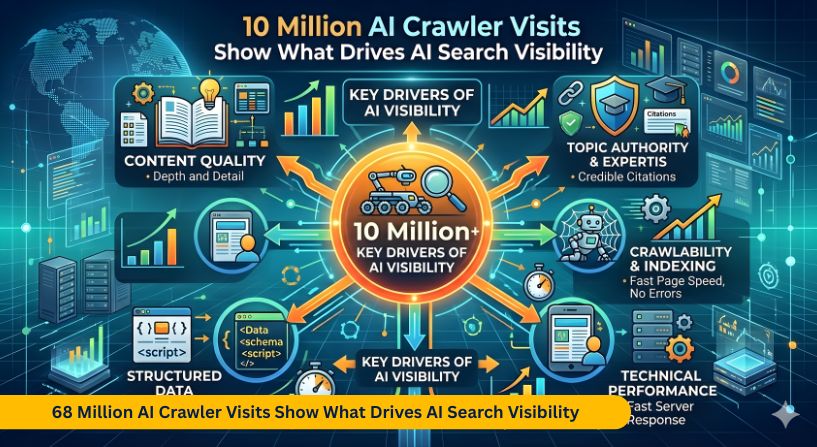
AI search is growing fast, and it is already changing how websites get traffic. A recent study analyzing 68 million AI crawler visits across more than 850,000 websites gives us a clear picture of how AI systems interact with websites and what helps a site gain visibility.
The biggest takeaway: AI search is no longer the future. It is already here.
AI Crawling Has Already Become Massive
AI systems such as ChatGPT and others actively visit websites not only to index them, but also to fetch information in real time.
- 68.9 million AI crawler visits occurred in one month.
- 59% of websites received at least one AI visit.
- More than 500,000 sites are already being crawled.
This means your website is likely already being seen by AI systems, whether you realize it or not.
AI Traffic Is Growing Quickly
- Total AI referrals increased by 72% in one year.
- ChatGPT traffic grew by 66%.
- Claude and Copilot showed massive growth from almost zero.
- Perplexity continues to show steady growth.
AI is becoming a real source of website traffic, not just an experiment.
AI Crawlers Are Changing How Content Is Used
Traditional search crawlers mainly stored and ranked pages. AI crawlers can fetch content when a user asks a question and use that material to generate a direct answer.
- 56.9%: real-time answer fetching
- 28.8%: training AI models
- 14.3%: traditional indexing
Your content can now be used instantly rather than simply stored for later.
One Platform Dominates AI Crawling
- OpenAI: 81% of crawler activity
- Claude: 16.6%
- Others: Perplexity and Google Gemini account for a much smaller share.
Optimizing for AI visibility today largely means making it easy for systems such as ChatGPT to access and understand your content.
Does AI Crawling Bring Real Traffic?
Websites that allow AI crawling show 3.2 times more human traffic, 2.7 times more form submissions, and 2.5 times more click-to-call actions. However, AI does not turn weak websites into successful ones. It tends to favor websites that already perform well.
What Increases AI Crawling?
1. External Integrations and Trust Signals
Websites connected to business directories, review platforms, and other external services tend to receive higher crawl rates. These connections help show that a business is real and verified.
2. Structured Business Information
AI prefers websites that clearly explain who they are. Include an accurate business name, address, phone number, business profiles, structured data, and well-organized pages. The easier your site is to understand, the easier it is to trust.
3. Content Depth
Sites with more useful content receive substantially more crawler visits. Websites with more than 50 blog posts received 33 times more crawler visits in the study. More content creates more opportunities for AI systems to use your information, although quality remains more important than quantity.
Local Business Data Matters
Local business websites with complete details, accurate contact information, and updated profiles received crawl rates as high as 82%. Clear business data helps AI identify the business, trust its information, and surface it in results.
AI Follows Real Demand
AI systems do not discover sites at random. They revisit websites that already attract users. Instead of chasing bots, focus on building a real audience, creating useful content, and growing your brand.
Final Takeaways
- Make your website easy for AI to understand.
- Add structured business information.
- Keep your content updated.
- Publish useful and relevant content regularly.
- Build real traffic and audience trust.
AI search is not about tricks or shortcuts. It rewards websites that are clear, trusted, active, and useful. If your website provides real value and is easy to understand, AI systems can naturally find and use it.
Source Reference: Search Engine Journal
To know more news - Google's Task-Based Agentic Search Is Disrupting SEO Today, Not Tomorrow